
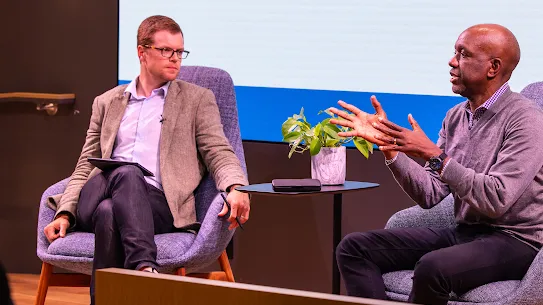
AI is rapidly transitioning from theoretical promise to a source of practical, real-world productivity, but ensuring it works for everyone requires a shared strategy. To explore what comes next -- the opportunities and the challenges -- Google and MIT convened the Work of the Future Initiative Summit last week, bringing together more than 70 senior leaders from across industries, academia, and policy who are at the forefront of this transition to discuss observations, best practices, and early research findings. One clear consensus emerged: by keeping people at the center of this transformation, we can help ensure that this powerful technology creates a more productive, innovative, and ultimately more human-centric world of work for everyone.
Here are the top 5 takeaways from the Work of the Future Initiative Summit.
1. Reimagining workflows to maximize impact.
For organizations, achieving AI’s economic potential hinges on fundamentally rethinking business processes from the ground up, rather than merely adding tools. True productivity emerges only when AI investments are matched by complementary organizational reforms. This involves a three-step process: identifying key organizational friction points, actively engaging the workforce to co-create augmented workflows, and systematically integrating AI to drive breakthrough productivity.
2. Elevating the human role.
The primary impact of AI at work is augmentation, not replacement. In general, AI handles routine tasks, freeing human workers to focus on higher value work like strategy, creativity, and complex problem-solving. It's a "force multiplier" for existing expertise, enabling a more productive and efficient workforce capable of solving the world’s most pressing challenges.
3. The workforce of the future is being built today.
AI has the potential to lift growth, wages, and living standards worldwide. But seizing this moment will require collective action from employers and employees alike, and is not guaranteed. From firms redesigning processes, to governments expanding infrastructure and building an enabling policy environment - the commitment to investing in human capital will be key to ensuring these gains are broadly shared.
4. Focus Wins: The 80/20 rule applies to AI.
Experimenting is important for organizational innovation, but focus is critical. Maturity means moving from hundreds of random projects to identifying the 10–15% of initiatives that deliver 80% of the actual value, and then deliberately scaling those high impact solutions. MIT calls this the “Try Everything, Calibrate, Scale and Shelve” approach.
5. Success is Human-Centric: trust and training are non-negotiable.
AI is only as good as the people who use it. The greatest barrier to realizing the potential of AI isn't the technology itself—it's the human element of trust. Companies must invest not only in reskilling and training their current workforce but also in co-developing new tools with employees to help ensure they feel empowered to use AI as an assistant that makes them better.