
- Utility Shift: Public perception has transitioned from AI as a curiosity to an essential tool for learning and time management.
- Sectoral Leadership: Education leads adoption, with a vast majority of students and teachers seeing AI as a net positive for learning.
- Collaborative Governance: Most citizens want governments and tech firms to co-develop AI solutions that improve access to public services.
This summary of the article below was generated using Gemini. It has been verified by site editors for accuracy.
In 2025, the world decisively crossed the AI adoption threshold. People moved past casual experimentation – the highest use case in 2024 – and embraced AI as an essential, helpful tool in their everyday lives. This profound shift from exploring AI's potential to regularly using it is the central finding of our third annual global survey with Ipsos, involving 21,000 interviews across 21 countries.
The AI adoption threshold: From entertaining to helpful
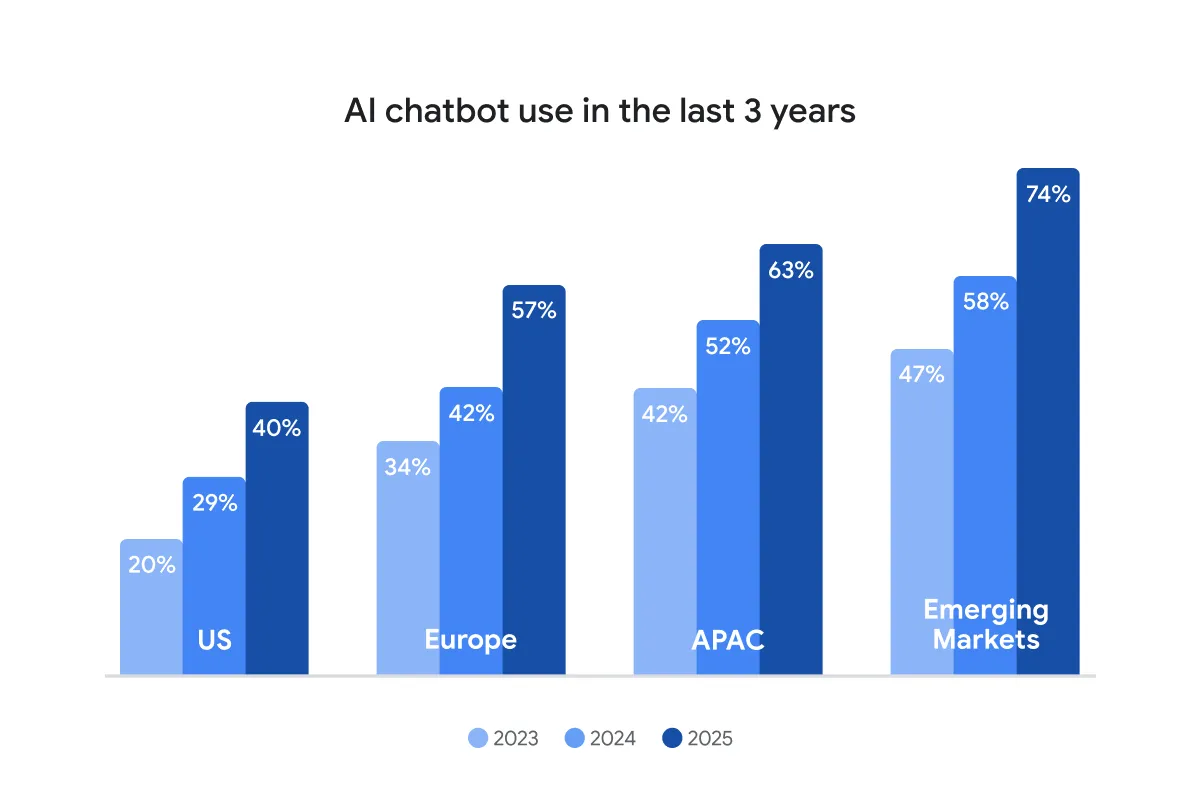
For the first time, majorities across all but a few countries report using an AI chatbot (from 38% in 2023 and 48% in 2024, to 62% in 2025). As adoption increases, the way people use these tools is also shifting from exploration to practical, tangible uses. People now rely on AI as a tool for learning and deep understanding (74% of users overall), saving time (65%), exploring new opportunities (42%) and helping make decisions (40%).
Education and learning: Students, teachers, and parents lead the way
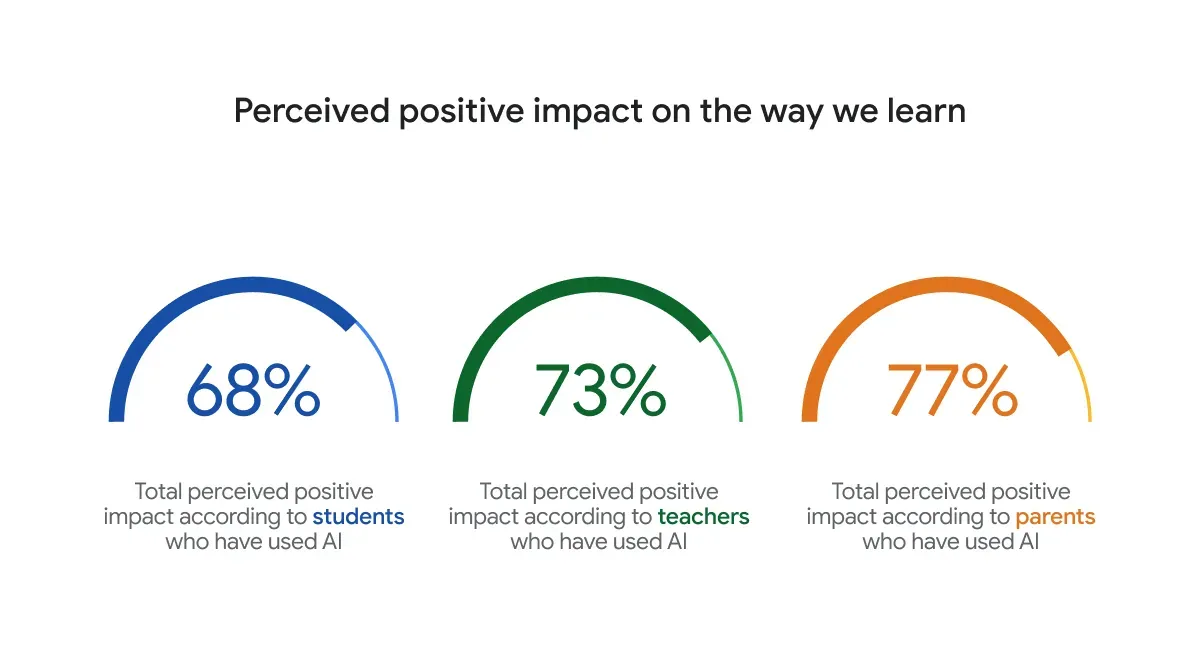
The most significant trend of the year is the embrace of AI for education. Teachers, students, and parents emerged as the AI "super users" of 2025 and are overwhelmingly positive about AI’s impact on learning. 85% of students 18+, 81% of teachers, and 76% of parents have used an AI tool, and a majority of each believe AI will have a positive impact on the way we learn. You can read more about the education findings here.
Experiencing is (still) believing: Users are the most excited about AI
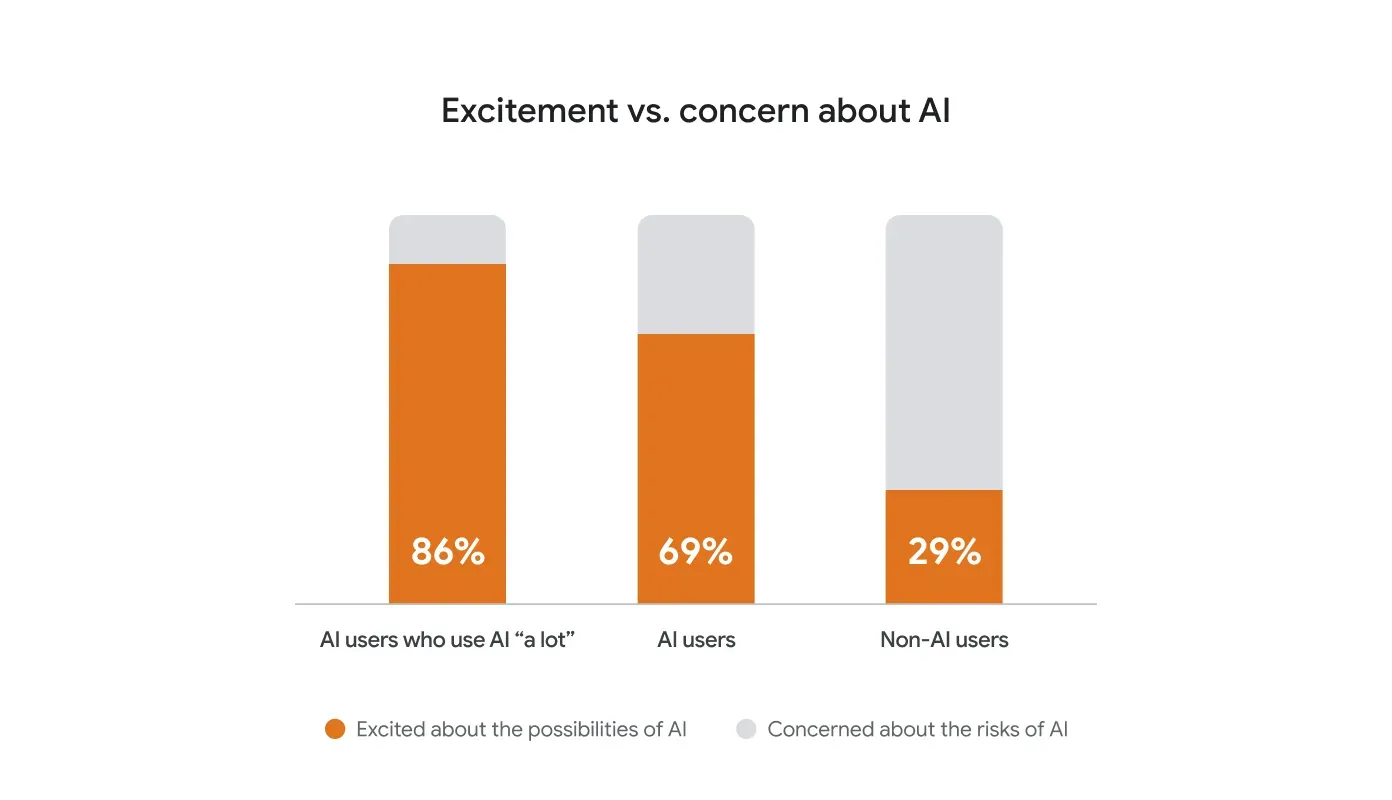
Familiarity with AI continues to create optimism. Globally, more than half of the public is more excited about the possibilities of AI (53%) than concerned about the risks (46%). 69% of those who use AI are excited about the technology, rising to 86% among those who use it frequently.
AI’s impact on the workforce: Balancing benefits and disruption
Optimism regarding AI’s impact on the workforce is rising: 66% of the global public now believes workers are likely to benefit from AI, a 13-point increase since 2023. Despite this optimism, the public is split 50-50 on whether benefits for workers will outweigh potential disruption, with workers leaning more optimistic (63% to 37%).
Trust and collaboration for responsible innovation
As AI becomes integrated into society, the public continues to support AI innovation. Globally, 58% of people believe fostering AI innovation in science and medicine is more important than protecting industries through regulation (41% favor regulation, consistent with 59% / 41% last year).
This desire for innovation is paired with a clear mandate for responsibility and collaboration: 74% of the public express confidence in tech companies to oversee AI, and 69% want to see governments and tech companies working together to use AI to help citizens access public services (69% support).
Looking ahead
Despite optimism globally, many still have concerns about AI. In the US, for example, just 33% of Americans are more excited about the possibilities of AI than concerned about the risks – despite an 11-point increase in reported AI chatbot usage in the last 12 months (from 29% to 40% of the US public). Canada and the UK show similar trends.
As in previous years, emerging markets feel the most optimistic about AI: countries like India and Mexico have sustained high levels of enthusiasm (69% excited for both) while simultaneously increasing AI usage (by 14 and 23 points, respectively).
As we move into 2026, these findings tell a story of a world that no longer sees AI as a futuristic curiosity, but a present-day tool that is actively used to learn, work, and grow.
Read the full report here.