


Link to Youtube Video (visible only when JS is disabled)
Google’s presence at the 2023 United Nations General Assembly focused on how AI and partnerships will be crucial to achieving collective solutions to the world’s most challenging issues.
At this year’s United Nations General Assembly (UNGA), the 17 Sustainable Development Goals (SDGs)—and how AI can achieve their implementation—were in the spotlight.
As governments, the private sector, and civil society work to achieve the SDGs by their 2030 target date, Google announced partnerships that are leveraging AI to advance their progress around the world.
“AI could be the game-changing development that the world desperately needs to make generational progress.” said Karan Bhatia, Google Vice President of Global Public Affairs and Government Relations. “Which is why our approach to AI has to be both bold and responsible. The core part of that is going to be working together, working collectively. We're optimistic coming out of an incredible week at UNGA that we've made some significant steps forward in doing that.”
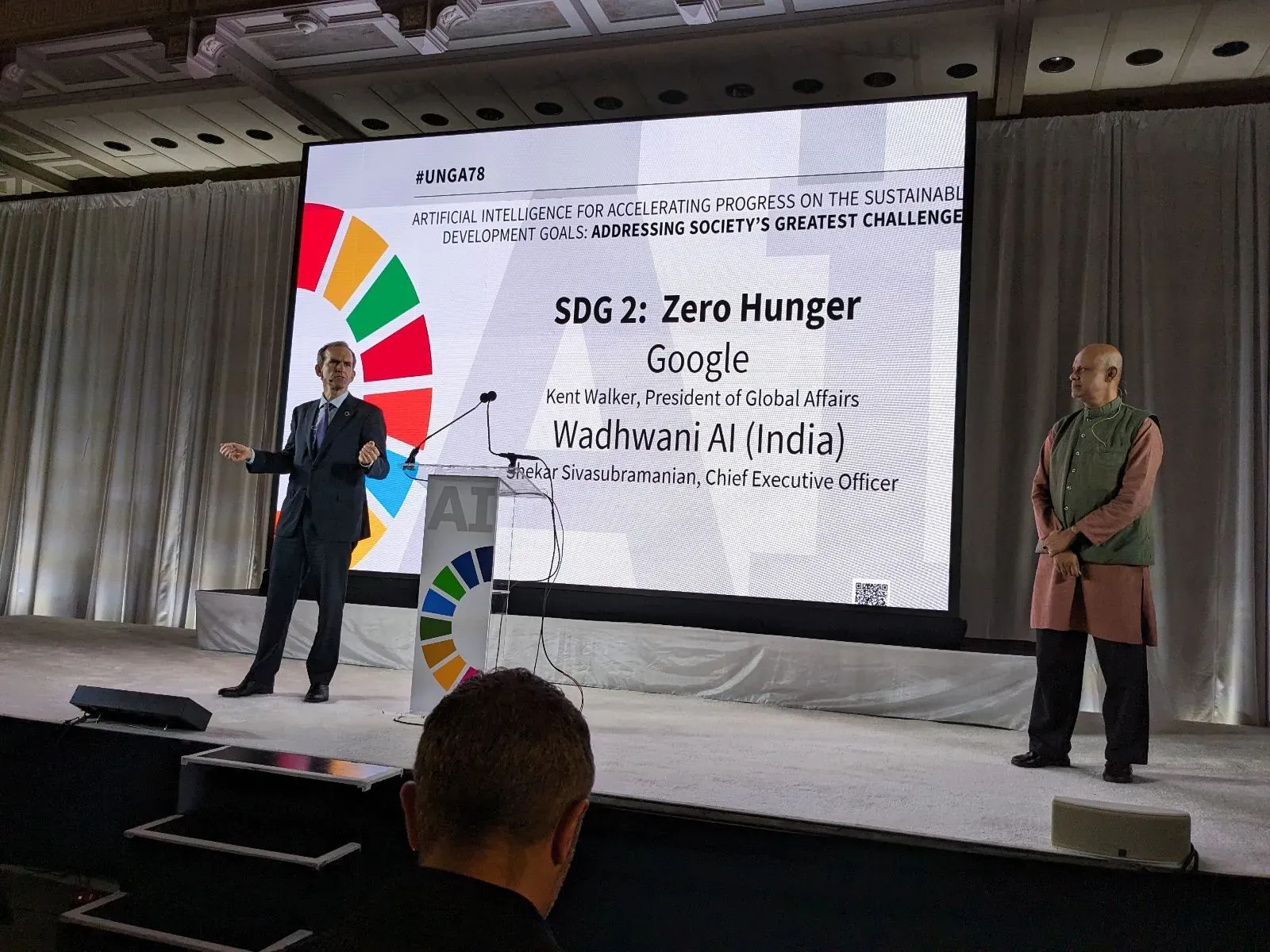
Google President of Global Affairs, Kent Walker on stage at the United Nations General Assembly with Wadhwani AI CEO, Shekar Sivasubramanian.
Making progress towards the SDGs with bold and responsible AI
This year, in collaboration with the Centre for Public Impact, Google announced a cohort of 15 organizations chosen to share in $25 million in funding through the AI for the Global Goals open call. These organizations are using the power of bold, responsible AI to address one or more of the Sustainable Development Goals —from improving road safety in Vietnam by the International Road Assessment Programme to the preservation of ten staple crops in India by Wadhwani AI.
As the world monitors progress towards the SDGs, one of the biggest challenges remains collecting and tracking reliable data. A partnership between Google.org, Data Commons, and the UN Statistics Division aims to address this. The new UN Data Commons for the SDGs tracks metrics across the 17 SDGs and offers a single source for official data, with AI-powered search functionality.
Data Commons’ long-term vision is to do for publicly available data what Google Search does for the internet or Google Maps does for navigation— organize it and make it accessible and useful.
In the face of climate change and natural disasters, AI has the potential to help billions of people. Flood forecasting is available in more than 80 countries where approximately 472 million people live. Access to this data can provide critical forewarning and save hundreds of lives by helping people get out of harm’s way.
AI is also helping aviation companies reduce the environmental impact of contrails. Google Research collaborated with American Airlines and Breakthrough Energy to review data like satellite imagery, weather and flight path data and create contrail forecast maps using AI that helped pilots reduce contrails by 54%. Contrails, the trails left in the sky by flying planes, trap heat and account for roughly 35% of aviation’s global warming impact. Reducing them could help mitigate this impact at the industry level.
AI has the potential to help make substantial gains toward achieving the UN’s SDGs. Partnership is a key component to ensuring AI is developed and deployed to maximize our collective progress towards achieving them.
Learn more about how Google is working to safely bring its users, and the world, the potential of AI by taking a responsible approach to innovation and prioritizing cross-sector collaboration.